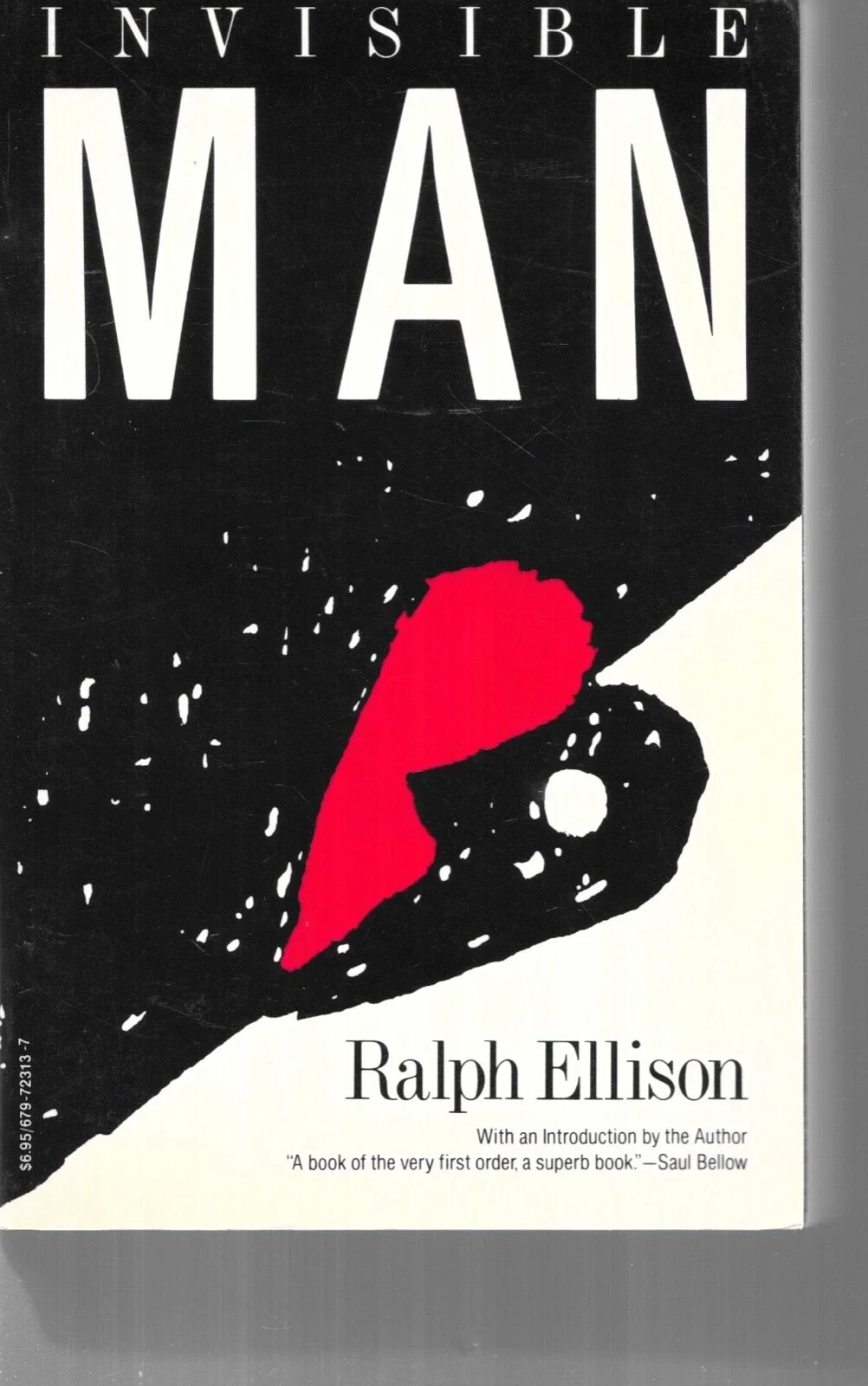
Invisible Man
“When one is invisible, he finds such problems as good and evil, honesty and dishonesty of such shifting shapes that he confuses one with the other, depending upon who happens to be looking through him at the time. Well, now I’ve been trying to look through myself, and there’s a risk in it.”
This book took me FOREVER to get through! Partially because I have read some smaller books while reading this and I changed my schedule with being busy. But it’s important to say that it is a longer read for me at almost 600 pages. It is that reason that it sat on my shelf for years before I picked it up. Eventually I had the courage to flip through the pages and finish it. One day that copy of Roots on my book shelf will also get read, not right now though.
What had happened was…
Our narrator begins the novel in an unlit basement, in this basement he is invisible to the world, not by some mystical event, but because people refuse to see him. However, he describes his existence in this self-described hole not as death, but hibernation. He then begins to tell us the story of how he became invisible in this hole. The narrator was a young man who showed a lot of promise, winning a speech competition and a scholarship to a nearby HBCU. When going to pick up his scholarship he finds a dark and sinister group who forces him into a “battle royale” or brawl amongst other young black men and to subject these young men to an electrified matt in order to win small amounts of money. This sinister group, which is comprised of the most dignified white men of his town, then force him to give his winning speech through his blood stained teeth. It is only then that he is presented his scholarship check.
Through this twisted and humiliating event the narrator is able to go to college. In his junior year whilst doing extremely well, a large benefactor of the school comes to visit. Because the narrator is a good student he is asked to be the liaison for the benefactor. The narrator takes the wealthy white man on a car ride and unknowingly onto some not too recently disinhabited slave shacks. However, one of these shacks is filled by a family that has been maligned by the Black community due to their open incestuous relationship. The shocking revelation of the incest causes the white benefactor to have a panic attack. The narrator young and dumb takes the benefactor to a nearby bar for a drink for the purpose of hopefully reconstituting the benefactor. However, the bar becomes rowdy and the narrator and benefactor barely get out of the establishment.
The president of the school comes to know of this and blames the happenings on the young narrator. He expels the narrator, however due to an impassioned speech from the narrator, the president agrees to send him to New York City with recommendation letters to other members of the board of directors of the school. The narrator leaves under the prospect that he will leave the school to go to New York only for a job to garner funds to return to the school. However, he not so quickly realizes that the entire plan was a farce from the beginning. The “recommendation letters” were actually letters pleading the other board members not to hire the narrator. His failure had been plotted from the beginning by a fellow Black man in the face of white benefactors to the school. The son of one of the benefactors pulls the narrator to the side, tells him the truth, and aligns him with a job.
Unfortunately, the job while easy comes with its own twists and turns. While working at the paint factory the narrator is almost killed (unclear as to whether it was intentionally) by an older Black man who feels threatened by the growing union which is forming in the factory due to the elder’s piety and loyalty to the company. The company takes the narrator to the “company hospital” administers shock therapy to his brain and issues the narrator a small paycheck for the work place accident in exchange for a waiver/release of liability. He is then released onto the street, extremely confused and unwell. While roaming the street he is found by a kind older Black woman, Mary, who rents him a room and nurses him back to health. Once back in health he witnesses an eviction, during the eviction he makes an impassioned speech to the onlookers pleading them not to harm the evictors as they are victims of the same system which is causing the eviction. The flames are increased when the police show up and the narrator is led to safety by a mysterious group we come to know as The Brotherhood.
The narrator becomes a paid member of The Brotherhood and uses these funds to repay Mary and move out. The narrator is paid largely for his speaking skills, however The Brotherhood becomes controlling over how, when and the subject matter of his speeches. The narrator believes that he can overcome this largely because he rises to power in the group and is put over Harlem, where The Brotherhood has struggled to gain Black visibility. However, after an interview not cleared by The Brotherhood, the group rips the narrator out of Harlem and sends him to Manhattan. In that time The Brotherhood loses its foothold on Harlem to Ras the Exhorter a Black nationalist not opposed to violent revolution. The narrator eventually returns to Harlem to find his friend who supposedly has left The Brotherhood. He finds his friend, but shortly after finding him witnesses his friend killed by the police. The narrator asks the Brotherhood to send a presence to Harlem however, they never respond. The narrator decides to lead a funeral for his friend and once again gives an impassioned speech to the people. However, The Brotherhood does not like the substance of the speech nor the fact that he gave it without their clearance.
Ras the Exhorter notices that The Brotherhood fails to galvanize the momentum following the funeral and blames the narrator. Ras who is a man willing to use violence makes the narrator nervous who begins to wear a slight disguise of glasses and a hat. In his time wearing this hat he is recognized by many as another man named Rinehart. In his time being recognized as Rinehart he is misgiven as a ruffian of various sorts by bartenders, police, and a few women. The narrator notices that whoever Rinehart is, he is also wearing a disguise in order to be recognized so differently by so many different people. It further entrenches this idea of the narrator’s own invisibility as glasses and a hat allow him to be seen as a completely different man.
He eventually finds himself at The Brotherhood office who once again reem him for using his skill in a way not deemed appropriate to The Brotherhoods plans. The narrator decides that he will, upon the advice of his formerly enslaved grandfather, yes them to death. So The Brotherhood once again rips him out of Harlem and decides to allow the Harlem branch to die on the vine. While once again speaking in Manhattan, and enjoying (?) a dalliance with the wife of a leader of The Brotherhood to gain information, the narrator is told that Harlem once again needs him. He goes and finds that Harlem is on fire due to a riot and he wonders whether The Brotherhood allowed this to happen by not stopping the advancement of Ras the Exhorter. During this riot he helps set a building on fire, gets into a physical alteration with Ras the Exhorter (renamed Ras the Destroyer) and while running from police/Ras’ acolytes he jumps into an open man hole cover. The police knowingly re-cover the man-hole and it is in this darkness that the narrator finds the true reasoning behind his invisibility. He has strived to define himself based on the needs of others, however these others never see the narrator, rather a pawn for their use. In this time away from society he decides to define himself and return to society anew.
Aiight so boom…
As you can see this is a long one with A LOT to be broken down. Many break down the battle royale, Rinehart, or the overall concept of invisibility. I will say that Emerson’s idea of invisibility is often limited to racism, but could easily be seen as a broader message about self-actualization (undoubtedly made harder by racism). I also really like the concept of the novel being in media res and the reader knowing it as it creates a destiny. At first I read this as a destiny of failure as eventually the narrator winds up in the hole, but by the end of the novel it is not the hole that matters, but the self-determination. As such, the narrator is destined to become visible. With that said, I want to talk about my initial dissatisfaction with the book. It ends with the narrator going into deep and explicit explanation of the concept of invisibility, however he never discusses how the narrator becomes visible. This is incredibly frustrating for the reader who sees many parallels with the concept of invisibility and wants to know how to break free of it. How does the narrator become visible? It is made clear that the key to visibility comes from self-definition and being able to fully see oneself. But it is never shown to the audience how or that the narrator achieves this self-definition. But when viewed from a meta-commentary, I began to love this fact. I love when writers use the medium of a novel to give the readers a feeling, Toni Morrison uses a long chapter in Song of Solomon for a character delaying another and in Atonement the author uses an incredibly boring first 100 pages to show the boredom of the polite English countryside family. Herein we see Ralph Emerson show that in self-definition the on-looker does not matter. We do not see the narrator’s self-determination because even we as the reader are third-party to this task. As such, it is not for us to view and judge these inner machinations, as the narrator is again at risk of once again defining himself by those judgements. We are not in the hole with the narrator. Instead we are distant from it and can only imagine the act completed as he comes back to the world anew. A brave act by the narrator and an even braver act from the author.